Paper 02
Rapid Technology Changes Keep Industries Mimetic
How compressed innovation cycles have made mimetic isomorphism the dominant institutional force, from the dot-com boom to the AI era.
- Status
- Released
- Date
- Nov 26, 2025
- Reading
- 8 min
Abstract
Each successive wave of technology, the commercial internet, social media, and now generative AI, has compressed the time available for organizations to build genuine expertise before they must respond. As that runway shrinks, mimetic isomorphism stops being one institutional pressure among three and becomes the default mode of organizational behavior. This paper traces that pattern across three eras and asks whether a new form of *algorithmic isomorphism* is now taking shape.
00 / Listen
Audio companion to this paper.
00 / Paper
Introduction
“The more things change, the more things stay the same” is a well-known proverb that applies strongly to business theory. DiMaggio and Powell's (1983) work highlights three pressures that keep organizations from acting uniquely: coercive isomorphism, which stems from “political influence and the problem of legitimacy”; normative isomorphism, which is “associated with professionalization”; and mimetic isomorphism, which occurs “when goals are ambiguous, or when the environment creates symbolic uncertainty.” With technology evolving faster than ever, organizations appear to be in a continuous state of mimetic isomorphism. To explore this idea, this paper examines three major technological eras, the boom of the internet, the social media surge, and the current AI environment, identifying mimetic drivers that surface when uncertainty and fear dominate.
“Uncertainty is a powerful force that encourages imitation.”
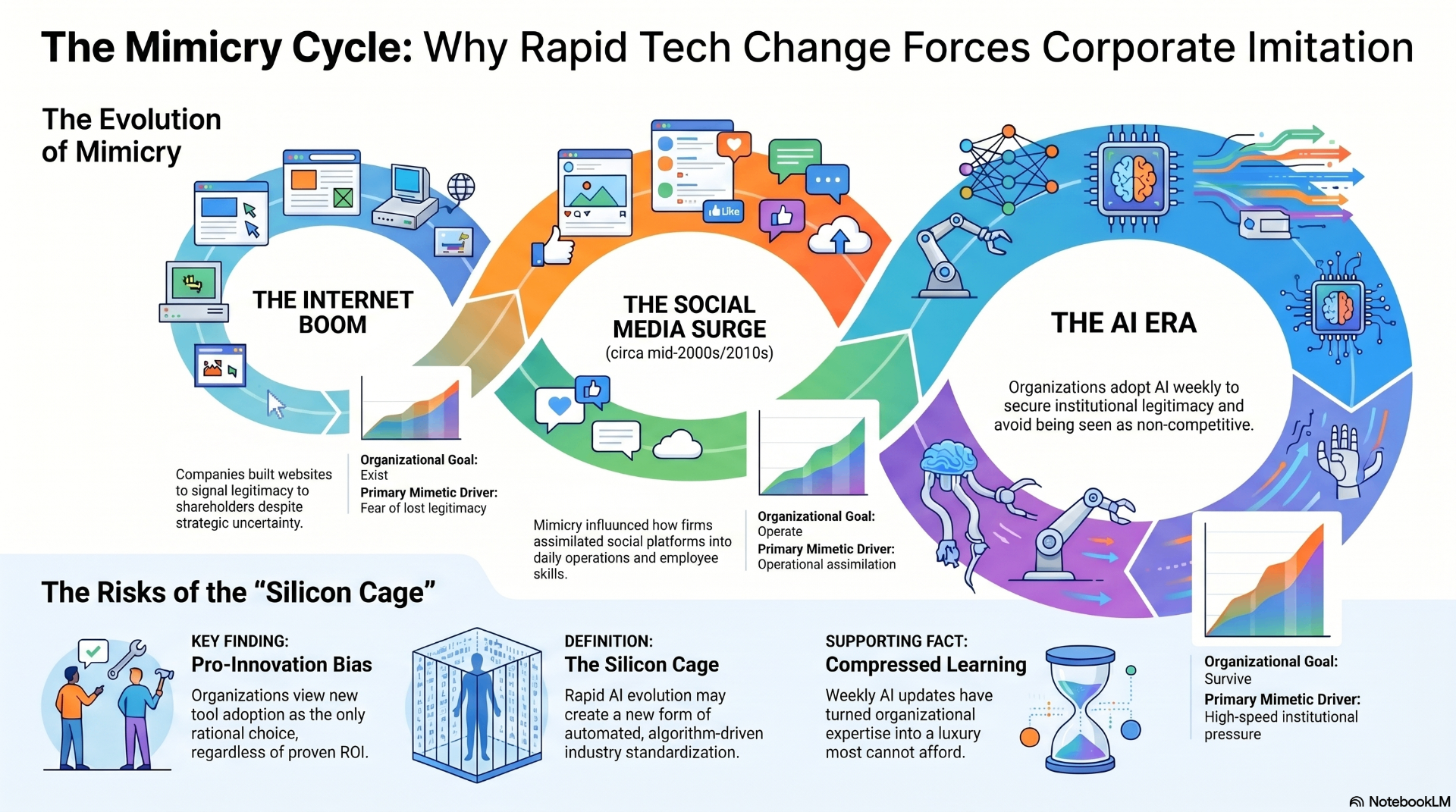
The Dot-Com Era, Mimicry to Exist
The dot-com boom was one of the largest technological periods of uncertainty in the past century. Company websites appeared rapidly, and businesses didn't know how to keep up or determine whether the internet was worth the investment. Ultimately, as a way to stay competitive, companies chose to jump on the bandwagon as “the fear of lost legitimacy” overpowered the technological uncertainty (Flanagin, 2000, p. 620). By adopting the trend of creating websites, businesses believed they could signal to customers and shareholders that they were embracing the emerging digital environment (Flanagin, 2000). Technological change outpaced the ability of the boardroom to formulate coherent strategies, and the fear of missing competitors' actions, combined with the uncertainty of new technology, made mimicry an essential response.
Social Media, Mimicry to Operate
As social media platforms became more established, companies were faced with understanding how to best use them in their businesses. Mimicry was a driving factor for assimilation during this era, but strategic adaptation was not guaranteed (Bharati et al., 2014). Social media assimilation was most impactful when employees embraced the change and their skill sets improved, not purely from top-down directives (Bharati et al., 2014). Notably, while Bharati et al. (2014) confirmed that mimetic pressures positively influenced assimilation, they found that normative pressures were not statistically significant. Given that DiMaggio and Powell (1983) define normative pressure as stemming from the “collective struggle of members of an occupation to define the conditions and methods of their work,” the failure of normative pressures to dominate while mimetic pressures remained significant further strengthens the argument that mimicry continually steers organizations through technological turmoil.
AI in 2025–2026, Mimicry to Survive
There has arguably been no technological turmoil larger than the AI era of 2025. As AI diffuses more rapidly than previous technologies, the speed at which institutional pressures act on organizations has accelerated as well (Reis & Pinheiro Junior, 2025). Reis and Pinheiro Junior (2025) identify mimetic isomorphism as a key driver of AI adoption, noting that organizations are adopting AI to secure institutional legitimacy while determining their ROI strategies later. They warn of a pro-innovation bias, where adopting new tools is automatically assumed to be the only rational choice. In this environment, organizations perceive the uncertainty of AI outputs as a necessary gamble to avoid being seen as non-competitive.
“Mimetic isomorphism is another key driver of AI adoption, organizations are adopting AI to secure institutional legitimacy.”
Some highly regulated industries, such as healthcare, will continue to be driven primarily by coercive pressures (Reis & Pinheiro Junior, 2025). But during the internet era and the rise of social media, companies had years to understand and develop best practices. Today that time is a luxury. Because AI evolves weekly, organizational changes often stem from mimicry rather than expertise.
| Era | Mimetic Mode | Time to Build Expertise | Anchor Source |
|---|---|---|---|
| Commercial internet (late 1990s) | Mimicry to exist | ~5–10 years | Flanagin (2000) |
| Social media (2000s–2010s) | Mimicry to operate | ~3–7 years | Bharati et al. (2014) |
| Generative AI (2023–2026) | Mimicry to survive | Weeks | Reis & Pinheiro Junior (2025) |
From Iron Cage to Silicon Cage
As every wave of new technology has reduced normative time cycles, mimetic isomorphism has become a stronger force than ever before. Companies must balance embracing new technologies to stay competitive with ensuring that employees are motivated to learn and apply AI effectively. The better an organization is at building absorptive capacity, the more likely it is to succeed (Bharati et al., 2014). Although the time available for learning is compressed, the importance of learning remains. Mimetic isomorphism is no longer a pillar of industry pressure; it is the foundation. During the early internet era, organizations mimicked to exist (Flanagin, 2000). During the rise of social media, organizations mimicked to operate (Bharati et al., 2014). Now, as AI shifts weekly, organizations mimic to survive (Reis & Pinheiro Junior, 2025).
If the rapid pace of change continues beyond any previous digital transformation, we may need to re-examine DiMaggio and Powell's work on the iron cage. More research is needed to understand how the antecedents of mimetic isomorphism affect organizations in this new digital wave, and to examine whether a new form of algorithmic isomorphism is emerging, potentially creating a “silicon cage” of automated standardization (Caplan & Boyd, 2018).
01 / Why I explored this
Across two decades of operating roles I watched the same scene play out three times: leadership facing a new technology with no time to understand it, then defaulting to whatever the loudest competitor was doing. Naming that pattern as mimetic isomorphism, and tracing how each successive wave compresses the runway further, turned an instinct into a working hypothesis.
02 / The question I was wrestling with
When the cycle of new technology compresses faster than organizations can build expertise, does mimicry stop being a strategy and become the only available behavior?
03 / Key insights
- 01
Each successive technology wave has shortened the time available to build expertise before responding, from years (internet) to months (social media) to weeks (AI).
- 02
When normative pressure cannot keep pace with technological change, mimetic pressure absorbs the slack and becomes the dominant mode.
- 03
Absorptive capacity, the organization's ability to recognize, assimilate, and apply new knowledge, is the moderating variable between blind mimicry and competent adoption.
- 04
Highly regulated industries remain partly insulated by coercive pressure, but everyone else is operating in near-pure mimetic conditions.
- 05
Algorithmic standardization may be producing a new form of isomorphism, a silicon cage, that compounds rather than replaces the iron cage.
05 / Visual summary
Across three eras, the time available to learn before mimicking has collapsed, and mimetic isomorphism has moved from pillar to foundation.
06 / Citations
5 citations▸
- Bharati et al., 2014
Bharati, P., Zhang, C., & Chaudhury, A. (2014). Social media assimilation in firms: Investigating the roles of absorptive capacity and institutional pressures. Information Systems Frontiers, 16(2), 257–272.
- Caplan & Boyd, 2018
Caplan, R., & Boyd, D. (2018). Isomorphism through algorithms: Institutional dependencies in the case of Facebook. Big Data & Society, 5(1).link
- DiMaggio & Powell, 1983
DiMaggio, P. J., & Powell, W. W. (1983). The iron cage revisited: Institutional isomorphism and collective rationality in organizational fields. American Sociological Review, 48(2), 147–160.link
- Flanagin, 2000
Flanagin, A. J. (2000). Social pressures on organizational website adoption. Human Communication Research, 26(4), 618–646.
- Reis & Pinheiro Junior, 2025
Reis, J. F., & Pinheiro Junior, L. P. (2025). Institutional theory (IT) and diffusion of innovation (DOI): A theoretical approach on artificial intelligence (AI). BAR, Brazilian Administration Review, 22(1), Article e240067.
07 / Related ideas
08 / Future questions
- — Is a distinct algorithmic isomorphism emerging, a silicon cage layered atop the iron one, and how would we measure it?
- — Can absorptive capacity be cultivated on weekly cycles, or does compressed diffusion structurally outpace organizational learning?
End of paper 02